

A world-first phase 3 trial has shown that adding a personalised mRNA cancer vaccine to standard immunotherapy significantly reduces melanoma recurrence, potentially ushering in a new era of cancer treatment.
An Australian-led international trial has shown that a personalised mRNA cancer vaccine can slash the risk of melanoma recurrence or death by 42% when combined with standard immunotherapy after surgery.
The landmark phase 3 INTerpath-001 trial, involving 1137 patients with high-risk melanoma, found that adding the investigational vaccine intismeran to pembrolizumab significantly improved recurrence-free survival compared with pembrolizumab alone.
The results, to be presented at the European Society for Medical Oncology (ESMO) Congress 2026 in Spain later this month, represent the first phase 3 evidence that a cancer treatment individually designed from a patient’s own tumour can significantly reduce the risk of recurrence or death.
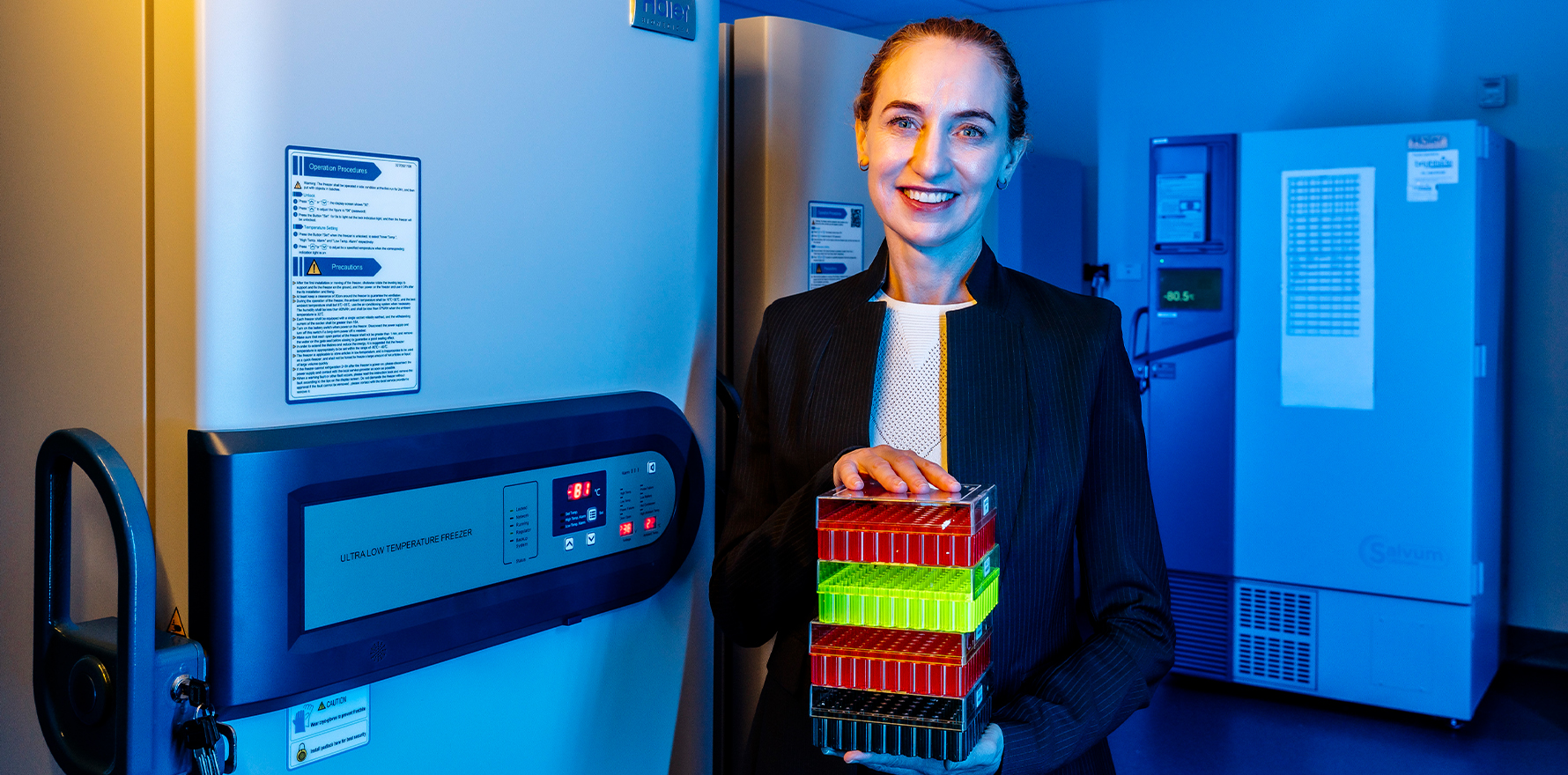
Led by Melanoma Institute Australia medical director Professor Georgina Long (pictured above in the institute’s biobank), the trial could pave the way for a new generation of personalised cancer therapies extending beyond melanoma.
“These findings are a foundational shift in our approach to cancer: harnessing the immune system in a more personalised way to reduce the risk of melanoma recurrence or death,” Professor Long said.
“This has not been achieved before in the history of cancer drug development. It is the coming together of technology, our biological understanding of cancer and the immune system, and the courage to take this idea into the clinic.”
The study enrolled patients with completely resected stage IIB to IV melanoma who were at high risk of recurrence and had not previously received systemic cancer treatment.
Patients received either intismeran plus pembrolizumab or pembrolizumab alone.
The combination reduced the risk of recurrence or death by 42% compared with pembrolizumab monotherapy (HR 0.58; 95% CI 0.45–0.75).
Among patients who remained recurrence-free beyond six months after starting treatment, the relative risk reduction reached 58% (HR 0.42).
Importantly, the addition of intismeran did not increase pembrolizumab-related adverse effects.
The vaccine was generally well tolerated, with mostly transient, low-grade side effects including injection-site pain, headache, and chills.
Unlike conventional vaccines designed to prevent infection, intismeran is a therapeutic cancer vaccine intended to stimulate an immune response against existing or residual cancer cells.
Also known as V940 or mRNA-4157, the investigational treatment uses genetic sequencing of an individual patient’s tumour to identify abnormal proteins, known as neoantigens, that distinguish their cancer cells from healthy tissue.
A mRNA vaccine is then manufactured to encode selected neoantigens, effectively teaching the immune system to recognise and attack cells carrying those tumour-specific markers.
Pembrolizumab, an anti-PD-1 checkpoint inhibitor, works alongside the vaccine by blocking inhibitory signals that prevent immune cells from attacking cancer.
Professor Long said the complementary mechanisms offered a fundamentally different approach to treating melanoma after surgery.
“We analyse a sample of each patient’s tumour to read its unique neoantigen fingerprint, then create a ‘wanted poster’ of the cancer,” she said.
“This is delivered as mRNA, so the body’s own cells display the poster to the immune system, showing it exactly what to look out for and attack.”
The trial was conducted across 157 sites internationally, including six Australian centres – the Melanoma Institute Australia, Westmead Hospital, One Clinical Research WA, Princess Alexandra Hospital, the Paula Fox Melanoma & Cancer Centre, and the Peter MacCallum Cancer Centre.
Professor Long was the global principal investigator and chaired the trial steering committee.
Westmead Hospital medical oncologist Professor Matteo Carlino, who led the trial at his site, said the findings had implications well beyond melanoma.
“It has been an incredible opportunity to be part of this Australian and international collaboration, contributing to the development of intismeran from its early phase development through to this groundbreaking trial,” he said.
“Intismeran has the potential to revolutionise the management of melanoma, and also multiple other types of cancer.”
Professor Alex Menzies, a medical oncologist and senior researcher at Melanoma Institute Australia, said the results demonstrated a substantial improvement over current adjuvant immunotherapy.
“This trial demonstrates that the addition of a personalised mRNA-based vaccine to current standard immunotherapy treatment leads to a major improvement in recurrence-free survival for those with high-risk, resected melanoma,” he said.
“The hope for the near future is that it may not only improve outcomes for melanoma patients with advanced disease, but also those with other types of cancer where current immunotherapies are poorly effective.”
Related



The findings build on more than a decade of advances in melanoma treatment, including BRAF-targeted therapies, immune checkpoint inhibitors, and more recently neoadjuvant immunotherapy.
Australia has one of the world’s highest melanoma rates, with approximately one person diagnosed every 30 minutes and one death from the disease every six hours, according to the MIA.
Despite major improvements in survival, preventing recurrence remains a significant challenge, particularly among patients with high-risk disease.
The phase 3 findings establish proof of concept for individualised neoantigen therapy, although further evidence will be needed to determine its impact on overall survival and its effectiveness in other cancer types.
Intismeran is being jointly developed by Moderna and MSD, which manufactures pembrolizumab.
The results will undergo regulatory review, a process that could take several years, and the vaccine is not yet available outside clinical research settings.
The findings are also expected to be published in the New England Journal of Medicine.
Professor Long said the success of the trial could mark the beginning of a broader transformation in oncology.
“Having succeeded in melanoma, this proof of concept could mark the beginning of a foundational shift in how we treat cancer, helping patients remain cancer-free for longer,” she said.
