

As the US faces an annual review of elimination status within months, a new study suggests the future for Australia is also concerning.
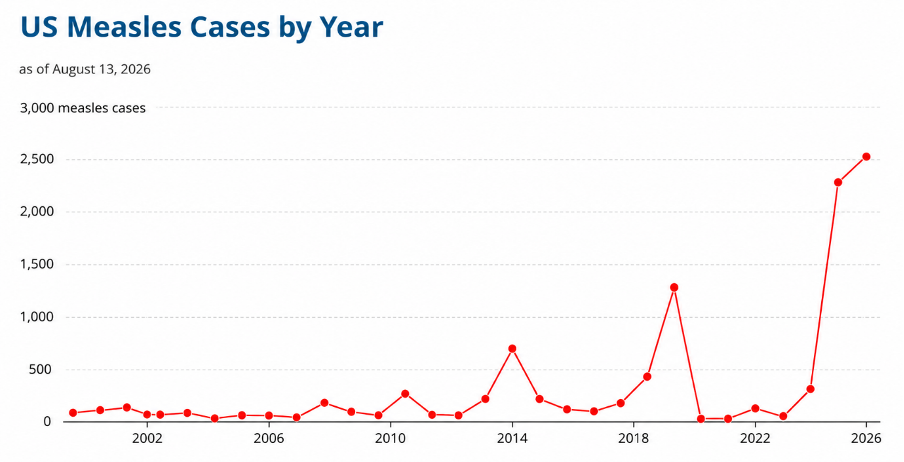
There were 2566 confirmed measles cases across the United States as of August 13, 2026, surpassing last year’s total of 2289.
Of the 2026 cases, 19% were in children under the age of five, 10% of whom were hospitalised. Nearly half of cases were in those aged 5-19 years.
“We are witnessing an avoidable crisis that disproportionally hurts children,” said American Academy of Pediatrics president Dr Andrew Racine.
“These thousands of cases represent real people in communities across the country, including babies hospitalised with pneumonia, students who have missed weeks of school, and parents forced to miss work to stay home and care for sick children.”
Measles elimination status was declared in 2000, and the Pan American Health Organization will be deciding whether that status is maintained in November this year at the annual meeting of the Regional Verification Commission for the Elimination of Measles, Rubella, and Congenital Rubella Syndrome.
There have been 38 new outbreaks (defined as three or more related cases) reported in 2026, and 94% of confirmed cases are outbreak-associated – 1032 from outbreaks starting this year and 1375 from outbreaks that started in 2025.
There were 48 outbreaks reported for the full year of 2025, with 90% of confirmed cases being outbreak-associated, compared to 16 outbreaks and 69% of cases for 2024.
“Halfway into 2026 the U.S. is experiencing the worst year for measles since 1991. After keeping measles under control for decades, the country has now experienced continuous outbreaks since January 2025,” Dr Racine told media.
“We should not accept this as our new normal. Unless we reverse this trend, America’s children will continue to pay the price.”
Only 6% of those infected this year had received at least one dose of the MMR vaccine, with 93% either unvaccinated or with an unconfirmed vaccination status.
“The more of us who are immunised, the more difficult it is for the virus to spread. It’s that simple,” he said.
“Since early last year, federal leaders have dismissed measles as benign and unavoidable and have spread misleading information about the MMR vaccine.
“Today, I want to remind parents that measles is not just a rash. The virus can interrupt the immune system’s memory, leaving a previously healthy child significantly more likely to get sick from any type of infection.
“Skipping or delaying the MMR vaccine is risky because paediatricians can’t predict which children will have serious symptoms from measles or who might end up in the hospital.”
There have been no deaths so far in 2026, compared to three in 2025.
As of 18th of August 2026, Australia’s National Notifiable Disease Surveillance System (NNDSS) reported 112 confirmed measles cases, compared to 181 for the full year of 2025 and 57 for 2024.
The US news comes just days after the publication of a study in the Australian and New Zealand Journal of Public Health, which found Australia’s measles immunity was hovering at the lower edge of the level needed for herd protection.
The national study estimated that 93.3% of Australians were protected against measles in 2019, leaving 6.7% susceptible – a figure that puts population immunity at the lower end of the WHO’s estimated 93-95% herd protection threshold.
Researchers from the National Centre for Immunisation Research and Surveillance and collaborating institutions said the findings highlighted immunity gaps in younger and middle-aged Australians despite sustained high childhood vaccination coverage.
The study combined data from four national serosurveys with Australian Immunisation Register data to estimate susceptibility across virtually the entire population.
Susceptibility was less than 1% among Australians born before the introduction of measles vaccination, but rose substantially among later generations.
For people born between 2000 and 2018, an estimated 7-14% were susceptible, while susceptibility reached 11% in the 1993-95 cohorts.
Overall, the researchers estimated 1.7 million people were susceptible in 2019, although the 95% uncertainty interval ranged from 1.3 million to 3.2 million.
The age distribution was also reflected in actual measles cases. Of 1800 cases reported to the NNDSS between 2008 and 2022, 50% were people aged 15-35 years, while 17% were children younger than five.
“Many of the cohorts with a higher measles-susceptible proportion in our study include people of child-bearing age – nearly 80% of people giving birth in 2019 were born between 1980 and 1994,” the researchers wrote.
“Children living in areas of low childhood vaccination coverage are at greater risk of measles infection if exposed to a case, and this risk increases with the intensity of contact with an infected parent or household member.
“These adult cohorts are also those most likely to travel internationally with more than a third of short-term Australian resident international departures in 2023/24 being people born between 1979 and 1998.”
The researchers suggested that vaccination of Australians travelling overseas was important to maintain measles elimination, given the role that returning travellers play in measles importation.
“Reviewing parent/carer measles vaccination status on the AIR or from other records as part of routine childhood vaccination appointments, or during antenatal appointments may also help address immunity gaps,” they wrote.
The researchers warned that Australia’s measles susceptibility across relevant age groups was broadly similar to that of the US, England, and New Zealand – countries with similar levels of sustained high measles vaccine coverage.
“Like Australia, these countries have all experienced measles outbreaks and concerns about ongoing outbreak risks, with the United Kingdom losing its elimination status between 2018 and 2021,” they wrote.
They said they believed this study was the first internationally to combine multiple consecutive serosurvey and population immunisation register data to estimate population measles susceptibility across all age groups at a national level.
“Population susceptibility is a key indicator of the risk for outbreaks, and avoiding outbreaks is an important component of maintaining measles elimination,” they concluded.
“Our estimate of overall measles susceptibility at the national level of 6.7% likely obscures higher susceptibility in certain geographic areas and population subgroups, which were beyond the scope of our study.
“Ongoing maintenance of Australia’s measles elimination status will depend on successful targeted efforts to optimise vaccination coverage across all areas, age groups and population subgroups, supported by robust surveillance and public health disease control activities.”
Australian and New Zealand Journal of Public Health, August 2026
