

A pair of international phase 3 trials support the use of upadacitinib in the treatment of severe alopecia areata in adolescents and adults.
Adolescent and adult patients with severe alopecia areata could soon have another oral treatment option available to them.
That’s based on the results of two phase 3 trials designed to test the efficacy, safety, and tolerability of upadacitinib, an oral reversible JAK inhibitor. The findings of the trials, published in JAMA Dermatology, “demonstrated a positive benefit-risk profile”, leading the researchers to conclude that “upadacitinib may be a potentially effective treatment option for this patient population”.
The UP-AA1 and UP-AA2 studies, a pair of global, randomised, double-blind, placebo-controlled, phase 3 trials, followed the same methodology. Adolescents (12-17 years) and adults (18-64 years) with severe AA (a Severity of Alopecia Tool [SALT] score of 50 or more for scalp hair loss at screening and baseline) and no spontaneous scalp hair regrowth during the past six months were eligible to participate.
After a 35-day screening period, participants received daily doses of 15mg upadacitinib, 30mg upadacitinib, or placebo for 24 weeks. The primary outcome after the treatment period was a SALT score of 20 or less after 24 weeks. There were a range of secondary outcomes captured, including clinician-reported outcomes for eyebrows and eyelashes, the proportion of patients achieving a SALT score of 0 (complete scalp hair regrowth), and changes in self-reported anxiety and depression.
There were 676 patients recruited as part of the UP-AA1 trial (270 in the 15mg upadacitinib group, 271 in the 30mg upadacitinib group, and 135 in the placebo group) and 723 patients recruited in the UP-AA2 trial (289, 289, and 145 in each group). Both cohorts were predominantly female (55.9% and 60.2%), while participants in UP-AA1 were slightly younger than participants in UP-AA2 (mean age 34.9 years compared to 36.8 years). There were a larger number of adolescent patients in UP-AA1 than UP-AA2 (64 [9.5%] versus 54 [7.5%]).
The mean duration of AA since onset was more than a decade for patients in both trials (11.5 years for UP-AA1 and 11.6 years for UP-AA2). The average SALT score at baseline was 84.0 for UP-AA1 participants and 83.8 for UP-AA2 participants. The majority of patients across both studies has previously used a systemic medication for AA (65.7% and 63.2% for UP-AA1 and UP-AA2, respectively).
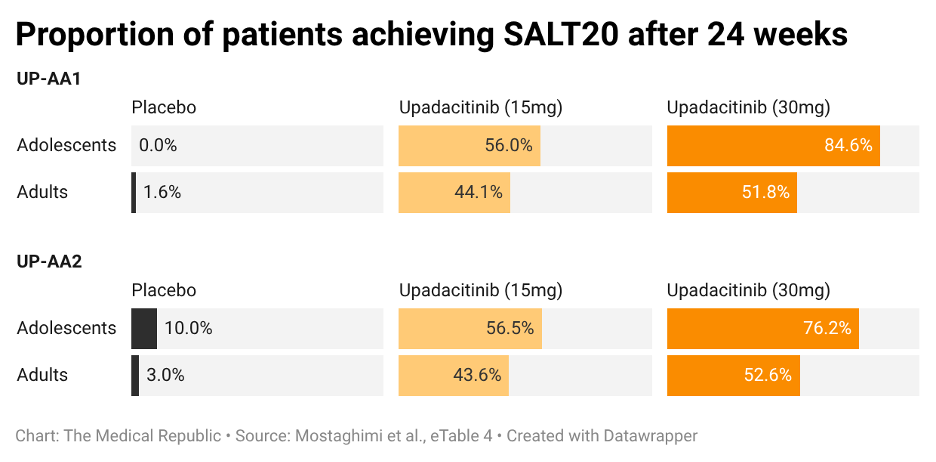
Both studies met the primary outcome. A greater proportion of patients from the 15mg and 30mg upadacitinib groups achieved a SALT score ≤20 after 24 weeks compared to the placebo group. For UP-AA1, 45.2% of patients treated with 15mg of upadacitinib and 55.0% of patients treated with 30mg of upadacitinib had SALT20 compared to 1.5% of patients in the placebo group. For UP-AA2, the proportions were 44.6% and 54.3% compared to 3.4%.
Both studies also met the primary outcome when adolescent and adult data were considered separately.
The hair-restoring effects of upadacitinib were seen at earlier timepoints in the treatment period. Across the two studies, there were 11.8% of patients in the 30mg group and 7.9% of patients in the 15mg group who had a SALT score ≤20 after eight weeks compared to 1.8% of patients treated with placebo. These proportions increased to 29.3% and 20.6% (compared to 1.4%) after 12 weeks.
The two doses of upadacitinib also outperformed placebo with respect to the proportion of patients achieving a SALT score ≤10 and a SALT score of 0 at the 24-week mark. For the former secondary outcome, the proportions for 30mg, 15mg, and placebo were 45.8%, 35.2%, and 0.7% in UP-AA1 and were 47.1%, 36.0%, and 1.4% for UP-AA2. When considering the latter secondary outcome, the proportions were 20.3%, 14.1%, and 0% for UP-AA1 and 22.5%, 13.5%, and 0.7% for UP-AA2.
Related



“Complete hair regrowth with upadacitinib treatment, demonstrated by the achievement of SALT score of 0 at week 24, showed statistical significance over placebo – a result that was not assessed as a key ranked end point in the primary analyses for the currently approved oral JAK inhibitors,” the researchers said.
“Recent data from global assessment studies show that complete scalp hair regrowth (SALT score of 0) is different in gradation (complete hair restoration) from more limited hair restoration. This distinction supports the concept of SALT score of 0 as a meaningful and aspirational goal in terms of an outcome measure of successful treatment for AA.”
Upadacitinib was also associated with greater eyebrow hair regrowth, greater eyelash hair regrowth, and greater reductions in anxiety and depression (defined as a score <8 on the anxiety- and depression-specific subscales of the Hospital Anxiety and Depression Scale).
“In a disease often associated with sizable psychosocial and emotional burden, [the] translation of clinical responses (hair growth) into meaningful patient-reported improvements becomes imperative to deem a treatment to be efficacious,” said the researchers.
Data from the two trials were pooled when it came to considering the safety of upadacitinib. Patients who received 30mg of upadacitinib reported a greater number of treatment-emergent adverse events (376) compared to patients in the 15mg upadacitinib (349) and placebo (160) groups. No deaths occurred and 23 serious adverse events were recorded (13 in the 30mg group, nine in the 15mg group, and one in the placebo group).
There were four adverse events that occurred in more than 5% of patients in any treatment group: acne (16.3% in the 30mg group, 11.7% in the 15mg group, and 3.6% in the placebo group), nasopharyngitis (12.0%, 12.0%, and 9.3%), upper respiratory tract infections (13.2%, 9.5% and 11.8%), and an elevated blood creatine phosphokinase level (6.6%, 5.2%, and 3.9%). Neutropenia was less common (3.9%, 2.2%, and 0.4%) but still occurred.
“No serious infections were reported in adolescent patients receiving upadacitinib,” wrote the researchers. “The safety profile of both doses of upadacitinib through 24 weeks was generally consistent across both studies, similar in adolescents and adults, and consistent with that observed in atopic dermatitis and other approved indications.”
The researchers felt their findings were robust due to the number of participants across the two trials. They were also encouraged by the fact that the beneficial effects of upadacitinib did not appear to plateau over the course of the trial, as previous studies have shown that the efficacy of baricitinib, deuruxolitinib, and ritlecitinib continued to improve after the 24-week mark.
“A third study is being conducted to assess long-term efficacy and safety and upadacitinib dose adjustments based on clinical response targets at week 52 of UP-AA1 and UP-AA2,” they noted.
