

A practical approach can help GPs diagnose it earlier, manage flares and know when specialist care is needed.
Around 4.7% of Australians report physician‑diagnosed chronic hand eczema6 (CHE), with higher rates in women and those in high‑exposure jobs such as hairdressing, cleaning and health care1,7-11.
Despite its prevalence and functional impact, CHE is often mistaken for other dermatoses, delaying effective management and referral.12
GP guidance outlines a practical “treat‑refer‑maintain” approach to recognise disease early, improve patient outcomes1-6, and avoid unnecessary impact on QoL19
What GPs are Seeing
CHE peaks between ages 30–39, often during peak working years1. The condition can limit manual tasks, disrupt work, and reduce quality of life. Patients frequently self‑manage with intermittent steroid use and avoidance strategies, allowing persistent and recurrent flares1-6, 12
A diagnosis of CHE is defined by the European Society of Contact Dermatitis criteria:
symptoms persisting 3 months or greater
or
recurring 2 or more times in 12 months2
Clinical Recognition, Definition and Subtypes
Chronic hand eczema (CHE) often has a relapsing course, and signs and symptoms can vary over time.
Diagnosis starts with a careful history — including when symptoms began, what triggers them, and any exposures at work or home. Examination should cover the palms, backs of the hands, web spaces, fingertips and nails, as well as other sites to rule out wider skin disease 19.
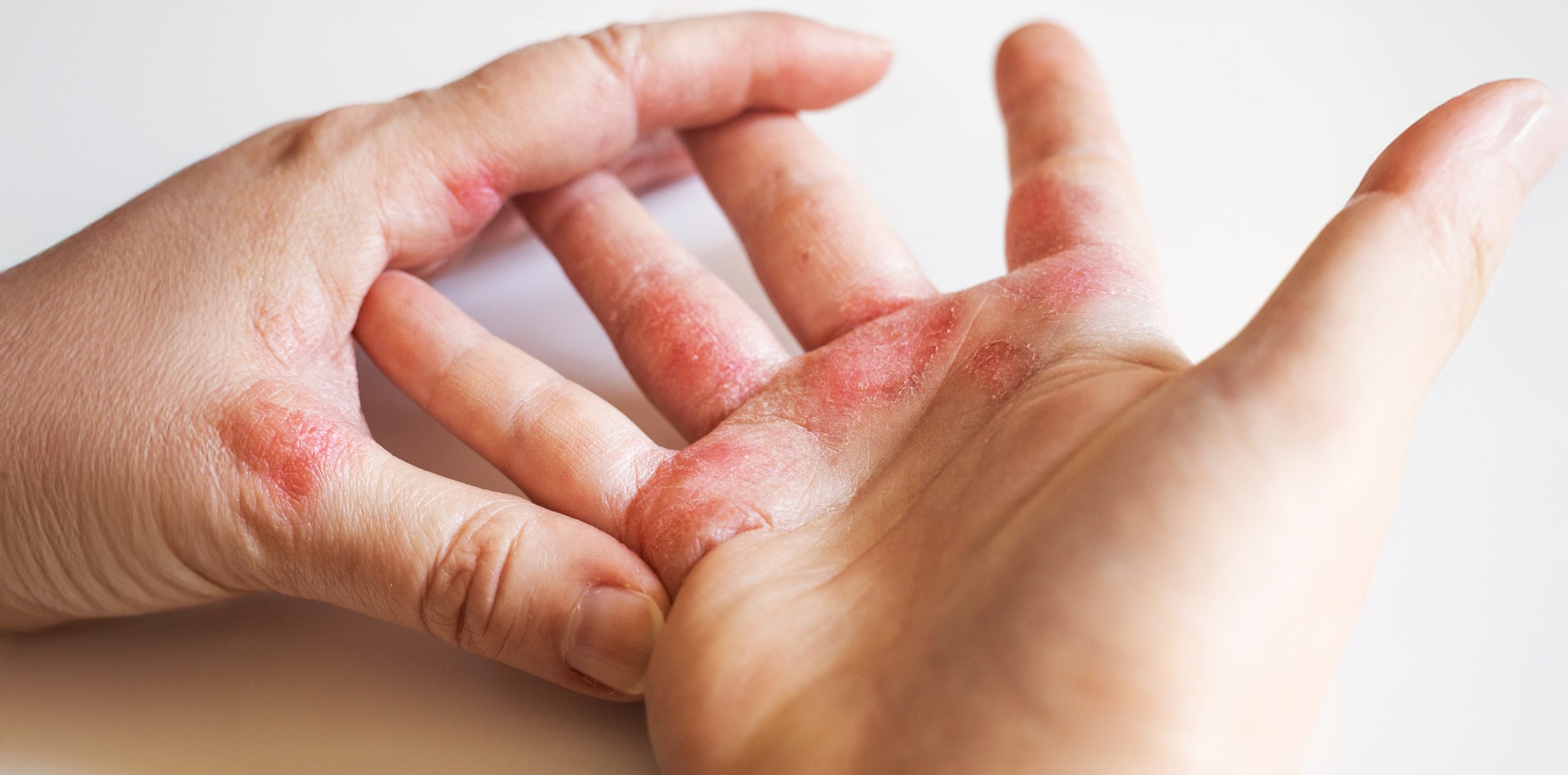
Typical presentation includes redness, scaling, dryness, fissures, vesicles and thickened skin (Figure 1). Itching and tenderness are common, often affecting hand function, and infection can complicate the course 1-6, 15-18.
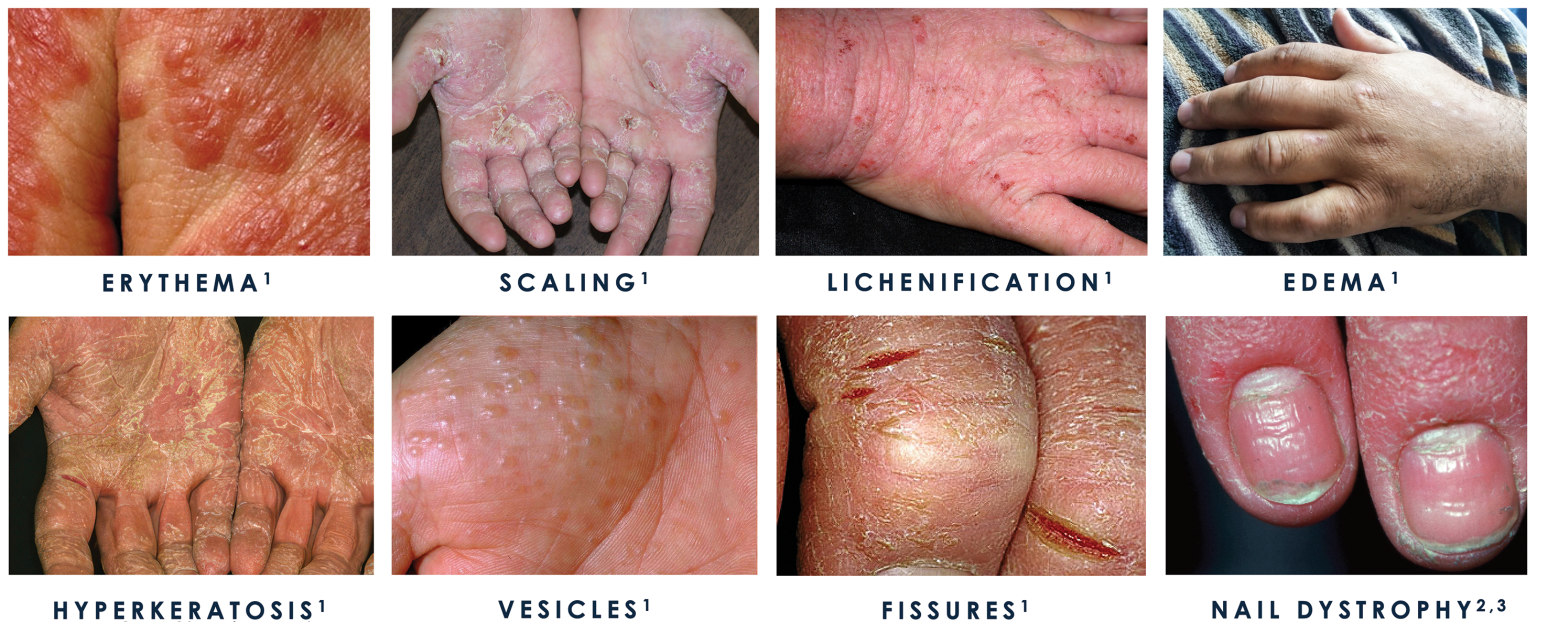
Underlying causes can be overlapping including: irritant or allergic contact dermatitis, atopic eczema, hyperkeratotic eczema, vesicular eczema, nummular eczema, or pulpitis. Recognising these patterns helps guide testing, management and referral decisions.2
Make the Diagnosis
In primary care, a structured history is key — covering symptom onset, occupational and domestic exposures, and any atopic background. Examine hands, wrists, nails, and check for other skin disease to refine diagnosis.
Photography can help track progress and support specialist referrals19
Differential Diagnosis in Chronic Hand Eczema12,20-29
Consider also other potentially treatable diseases:
- Tinea mannum
- Scabies
- Palmar psoriasis
- Palmoplantar Pustulosis (PPP)
- Lichen planus
- Squamous cell carcinoma in situ (SCCIS)
Persistent, solitary lesions should be biopsied to exclude skin cancer before escalating therapy.
Consider the impact on the patient
CHE can impact aspects of daily life including domestic chores; ability to work; relationships and more. Discuss with your patients how their hand eczema is impacting their Quality of Life1-6, 19
First‑Line That Works1,2,15,19,30-33
For mild–moderate CHE:
- Emollients
- Topical corticosteroids – long‑term overuse can lead to skin atrophy and functional impact6,7
- Hand care education, trigger avoidance, and maintenance plans are essential.
When to Refer 2,15,19,34
Refer after 4–6 weeks if initial therapy fails, diagnosis remains uncertain, or patch testing is required8,9 Occupational cases may need workplace assessment and formal reporting.
Information to include in a referral letter:
- Patient details: age, gender, contact information, interpreter needs, and note if neurodiverse, gender diverse, has a disability, or is pregnant/lactating.
- Indicate if the condition is unresponsive, high‑impact, or has recurrent episodes.
- Summary of prior management: treatments given, adherence to the plan, and outcomes.
- Clinical findings: include post‑treatment photos and note any atypical features.
What’s New?13,14,19,35
For moderate–severe CHE where topical corticosteroids are inadequate or inappropriate, delgocitinib cream received TGA approval in 2025. This topical JAK inhibitor is non‑steroidal and may be considered as an option where emollients, corticosteroids, and avoidance strategies fail.
CHE at a Glance – STEP BY STEP
- Recognition: >3 months or ≥2 flares in 12 months2
- Prevalence: 4.7% of adults live with chronic hand eczema 6
- GP essentials: emollients + topical corticosteroids; educate; avoid triggers; maintenance plans1,2,15,19,30
- Refer when: uncertain diagnosis, inadequate response after 4–6 weeks, need for patch testing, occupational disease2,15,19,34
Bottom Line1,6,19,34
CHE is a common, function‑limiting skin condition where GPs can make a decisive difference. Early diagnosis, adequate therapy, and timely referral prevent chronicity, reduce disability, and improve patients’ quality of life.
References:
- Weidinger S, Novak N. Hand eczema. Lancet. 2024;404(10470):2476-86.
- Thyssen JP, et al. Contact Dermatitis. 2022;86(5):357-78.
- Quaade AS, et al. Contact Dermatitis. 2023;89(6):453-63.
- Siewertsen M, et al. J Eur Acad Dermatol Venereol. 2024;38(11):2110-7.
- Cazzaniga S, et al. J Eur Acad Dermatol Venereol. 2016;30(4):628-37.
- Apfelbacher CJ, et al. Contact Dermatitis. 2019;80(1):45-53.
- Thyssen JP. Contact Dermatitis. 2010;62(2):75-87.
- Behroozy A, Keegel TG. Saf Health Work. 2014;5(4):175-80.
- Jamil W, et al. Acta Derm Venereol. 2022;102:adv00681.
- Hamnerius N, et al. Acta Derm Venereol. 2021;101(9):adv00543.
- Crepy MN, et al. Exploring the relationship between chronic hand eczema occupation, and household/leisure activities; Poster 19. European Society of Contact Dermatitis (ESCD) congress; Dresden, Germany. Sept 04-07; 2024.
- Elsner P, Agner T. J Eur Acad Dermatol Venereol. 2020;34 Suppl 1:3.
- Leo Pharma Pty Ltd. Australian Product Information – Anzupgo® (Delgocitinib) cream. 2025.
- Therapeutic Goods Administration. ANZUPGO delgocitinib 20 mg/g cream tube (470745). Available from: https://www.tga.gov.au/resources/artg/470745. [Accessed June 2026].
- Rademaker M, et al. Australas J Dermatol. 2021;62(1):17-26.
- Lee GR, et al. Dermatol Ther. 2019;32(3):e12840.
- Mernelius S, et al. Eur J Clin Microbiol Infect Dis. 2016;35(8):1355-61.
- Balato A, et al. J Eur Acad Dermatol Venereol. Published online 29 September 2025.
- Silverberg JI, et al. Am J Clin Dermatol. 2026.
- Chamorro MJ, et al. Tinea Manuum. In: StatPearls. Treasure Island (FL): StatPearls Publishing; 01 March 2024.
- DermNet. Scabies. Updated March 2022. Available from: https://dermnetnz.org/topics/scabies. [Accessed June 2026].
- Kimmel GW, Lebwohl M. Psoriasis: Overview and Diagnosis. In: Bhutani, T., Liao, W., Nakamura, M. (eds) Evidence-Based Psoriasis. Updates in Clinical Dermatology. Springer, Cham; 01 July 2018.
- Park JY, et al. J Am Acad Dermatol. 2017;77:130-135.
- DermNet. Palmoplantar pustulosis. Reviewed and updated, Sep 2014. Available from: https://dermnetnz.org/topics/palmoplantar-pustulosis. [Accessed June 2026].
- English, John SC. Chapter 5. Hand and foot dermatoses. In: General Dermatology: An Atlas of Investigation and Diagnosis. Atlas Medical Publishing Ltd; 2007.
- Arnold DL, Krishnamurthy K. Lichen Planus. [Updated 2024 Oct 29]. In: StatPearls [Internet]. Treasure Island (FL): StatPearls Publishing; 2025 Jan. Available from: https://www.ncbi.nlm.nih.gov/books/NBK526126/. [Accessed June 2026].
- American Cancer Society. What are Basal and squamous cell skin cancers? Available from: https://www.cancer.org/cancer/types/basal-and-squamous-cell-skin-cancer/about/what-is-basal-and-squamous-cell.html. [Accessed June 2026].
- DermNet. Intraepidermal squamous cell carcinoma. Updated May 2023. Available from: https://dermnetnz.org/topics/intraepidermal-squamous-cell-carcinoma. [Accessed June 2026].
- Mahler V. J Dtsch Dermatol Ges. 2016;14(1):7-28.
- Carøe TK, et al. Contact Dermatitis. 2018;78(1):55-63.
- Egeberg A, et al. JAAD Int. 2024;14:77-83.
- Christoffers WA, et al. Cochrane Database Syst Rev. 2019;4(4):Cd004055.
- Christensen MO, et al. J Am Acad Dermatol. 2024;91(6):1094-103.
- Victoria Department of Health. Assessment of dermatitis (eczema) management. Available from: https://www.health.vic.gov.au/statewide-referral-criteria/assessment-of-dermatitis-eczema-management. [Accessed June 2026].
- Pharmaceutical Benefits Advisory Committee (PBAC). November 2025 PBAC meeting outcomes. Available from: https://www.pbs.gov.au/info/industry/listing/elements/pbac-meetings/pbac-outcomes/recommendations-made-by-the-pbac-november-2025. [Accessed June 2026].
This article is based primarily on the “Research Review Educational Series, Chronic Hand Eczema: A practical guide for GPs”, which includes independent expert commentary by Associate Professor Monisha Gupta. The source publication was commissioned by LEO Pharma Australia Pty Ltd, and states that its content was prepared independently and based on published studies and expert opinion.
MAT – 97133